
@/ the 60th Venice Biennale
Oct 6, 2024
La Biennale di Venice, the Venice Biennale,* needs no introduction. She is an international large-scale festival, held and hosted annually by the Biennale Foundation, in the historic, picturesque, and awe-inspiring island city-state of Venice, Italy. With an affecting programming that holistically encompasses theatre, dance, music, cinema, and art, the International Arts Exhibition - since its inaugural opening in 1895 - has been consistently welcoming a staggering number of visitors from all over the world, every other year. Dubbed the “great mother” of all Biennale activities, on which others have been modelled after, it has a legacy of being the original and longest-running contemporary visual arts event.* The International Art Exhibition has maintained its prestige throughout the years as the organisation and its appointed curator have a notable track record in its capability to put together and stage an impressive and ambitious display of standard and acclaim. Renowned as the most important arts event on the calendar, the Biennale Arte not only sets up anticipation for upcoming global trends in visual culture, but also opens up the possibilities to present renewed perspectives and allow for the conscious facilitation of critical discourse on pointed themes in current politics, present culture, and recent social issues through art.
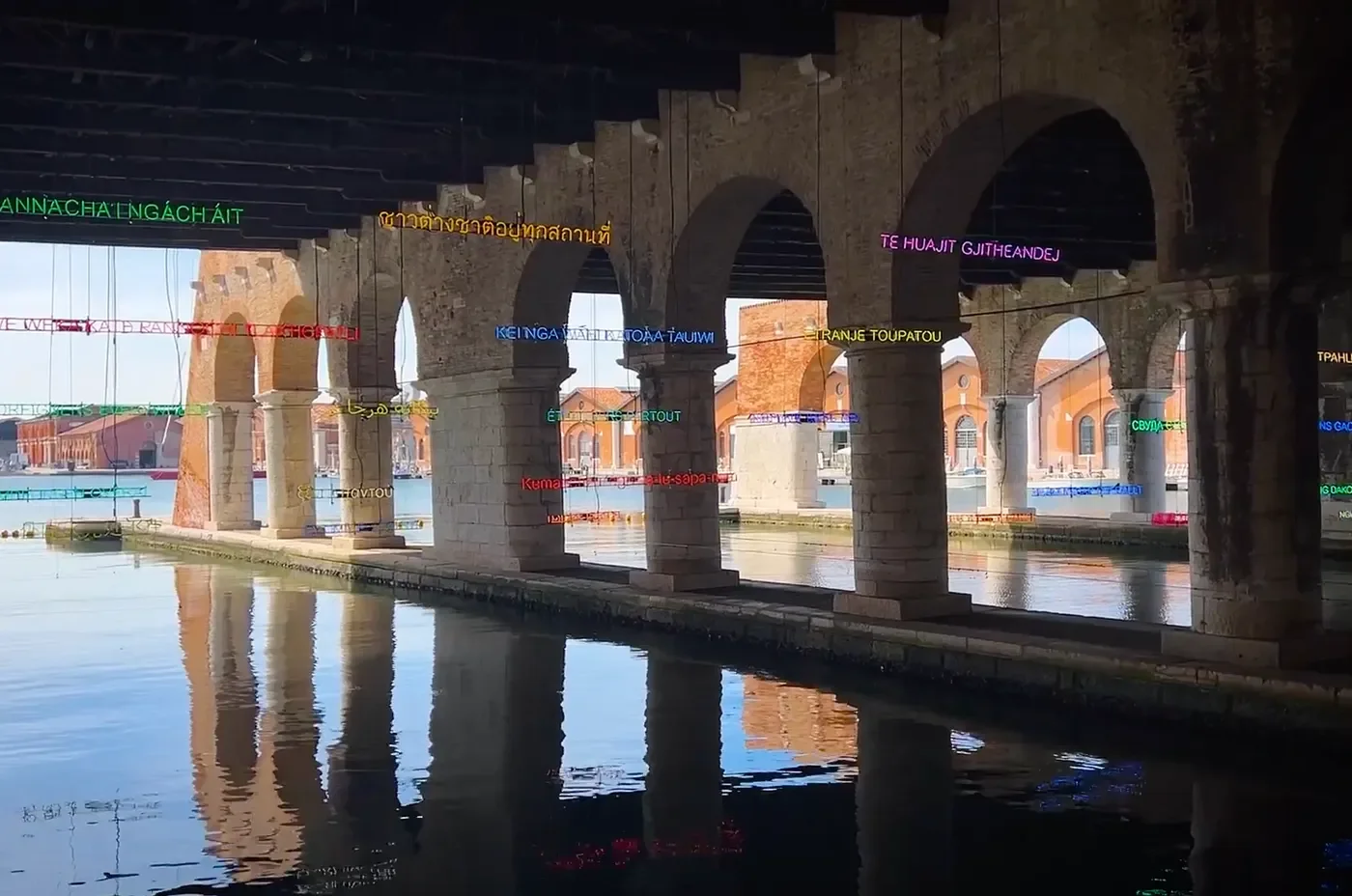
Foreigners Everywhere on display at the Venice Arsenale (Image Credit: Myself)
a glimpse at the title_
Returning in 2024, the 60th Venice Biennale will be open to the public for the usual six-months period, over the summer, from 20th April to 24th November. Appointed to helm this year’s ‘diamond-anniversary’ edition, and the Biennale’s first-ever Latin American curator in its illustrious 130-years timeline, is Adriano Pedrosa - artistic director of the Sāo Paulo Museum of Art (MASP), in Brazil. Laid bare in its title, ‘Foreigners Everywhere — Stranieri Ovunque’, Predorsa has contentiously and unambiguously made clear his curatorial vision for the exhibition as ‘a Provocation’.* In these disquieting words lie the evocative and poignant implications of a wider global context rife with its multitudinous crises, and made ever more apparent and critical. Drawn from a series started in 2004 by the Paris-born and Palermo based Claire Fontaine Foundation,* Foreigners Everywhere (2004/24) comprises of numerous neon sign sculptures lit up in various bright colours and spans several different languages. The other half of the expression, ‘Stranieri Ovunque’, is derived from the name of an anarchist collective from Turin that fought against racism and xenophobia in Italy during the early 2000s.
Without context, ‘Foreigners Everywhere’, by itself, puts forward a factual statement, which unreservedly picks at an enigmatic yet pervasive sense of unease. Appropriated as the title, direction, and voice of this year’s Venice Art Biennale, the phrase is further projected onto an exponentially larger scale and global lexicon as the exhibition event reputedly receives a far-reaching international audience. Alongside the higher stakes and increased scrutiny in today’s post-imperialistic, post-colonial, and globalised world, where multifarious global conflicts run rife and crises concerning the movement of peoples across increasingly hardening borders become more common. The title, therefore, acutely makes implicit an underlying sense of threat and conjures estrangement of feeling / being foreign. In this effect, the work compellingly embodies and projects the ambivalence of alienation onto the various sites and setting it encounters - a circumstance that is supposedly even more so relatable and decipherable for a growing and general population.
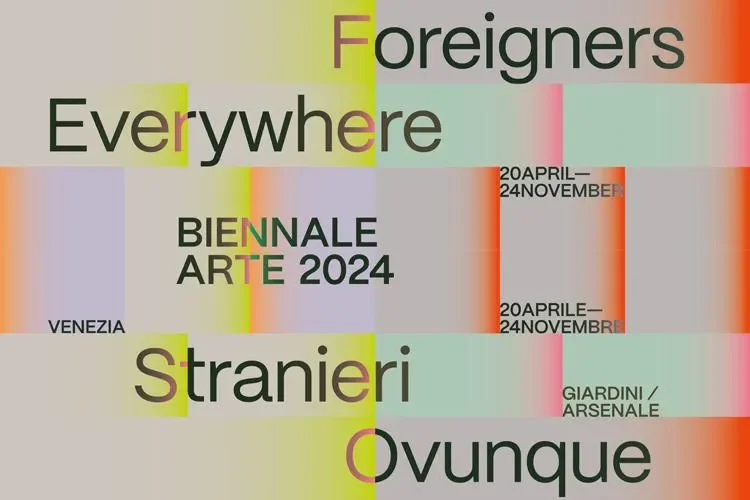
As Pedrosa expounds, “First of all, wherever you go and where you are you will always encounter foreigners—they/we are everywhere. Secondly, that no matter where you find yourself, you are always deep down inside a foreigner.”
“Foreign”, and its accompanying notions of ‘strange’ and ‘unfamiliar’, as a state of being - a reality for many who have found themselves in the position of identifying as an ‘other-related subject’ - is, thus, central to the exhibition. According to Pedrosa, ‘Biennale Arte 2024’s primary focus is the artists who are foreigners, immigrants, expatriates, diasporic, exiled, or refugees — particularly those who have moved between the Global South and the Global North.’¹ He recognises the immense platform and springboard that the Biennale provides to the arts and artistic careers, and has utilised this potential factor to make visible particular topics and themes, artists and artworks, that were hitherto either never substantially afforded or practically denied any, or much, attention. Therefore, this year’s biennale holds the latent possibility for political provocation and groundbreaking subversion as it aims to address, almost as a base criterion, and host a sample of the systematically marginalised, excluded, oppressed - with an exhibiting selection that places a strong emphasis on the ‘Global South’ and overarchingly feature figures like : the Queer artist, the outsider artist, the folk artist, and the Indigenous artist, amongst the numerous different labels for ‘Other’.
provenance of a location_
This notion reverberates nowhere better than through the waters and canals of the historic Venetian lagoon, la Serenissima — ‘the Most Serene Republic’,² once the traditional name for the republic. Spread over some 126 small islands, across the calm and shallow enclosed bay, the ‘floating city’ of Venice - with its unique network made up of walkways, bridges, and canals - illustrates a highly complex and persevering interaction between people and the testing and unstable ecology of their natural environment. The city-state and its lagoon, throughout their longstanding development, tracing back to the 9th century BC, boosts an extraordinary showcase of cultural, architectural, and engineering achievements and expectantly has been listed as a UNESCO World Heritage Site since 1987.* Considered to be an enviable financial and maritime power during its height, from the 13th to the 17th century, as an important centre of commerce - the Venetians managed to build and sustain a presence that still manages to attract and impress today. Beneath these accolades and the city-state’s current reputation as a major destination, Venice, in actuality, has survived and precariously exists as a vulnerable and fragile city.
Threatened by saturation tourism and the climate crisis, most prominently, due to the rising sea levels, Venice is - literally and metaphorically - a city that is constantly on the verge of sinking. Emerging from a quaint fishing village, the original population and landscape of the lagoon consisted of refugees, from the nearby towns and undefended countryside, who were seeking shelter from successive waves of invasion, and temporary settlements. Not to mention, over its expansion and through the context of the city-state’s productive trading relationship with the eastern Mediterranean and Asia, Venice has gained, since 1000 AD, and even goes by a name in Arabic — al Bunduqiyah (بندقية).³ As the only European city to procure such a regard, a multitudinous assemblage of meanings is layered and function as an appropriate and fecund counter facet to the discourse that the 60th Venice Art Biennale is attempting to probe with its title and titular artwork, “Foreigners Everywhere”. Once again, Venice - a city which first had the idea of staging and hosting an International Art Exhibition - has become a site where meetings and communications between different people are facilitated, where curiosity is fostered, and where knowledge is renewed.
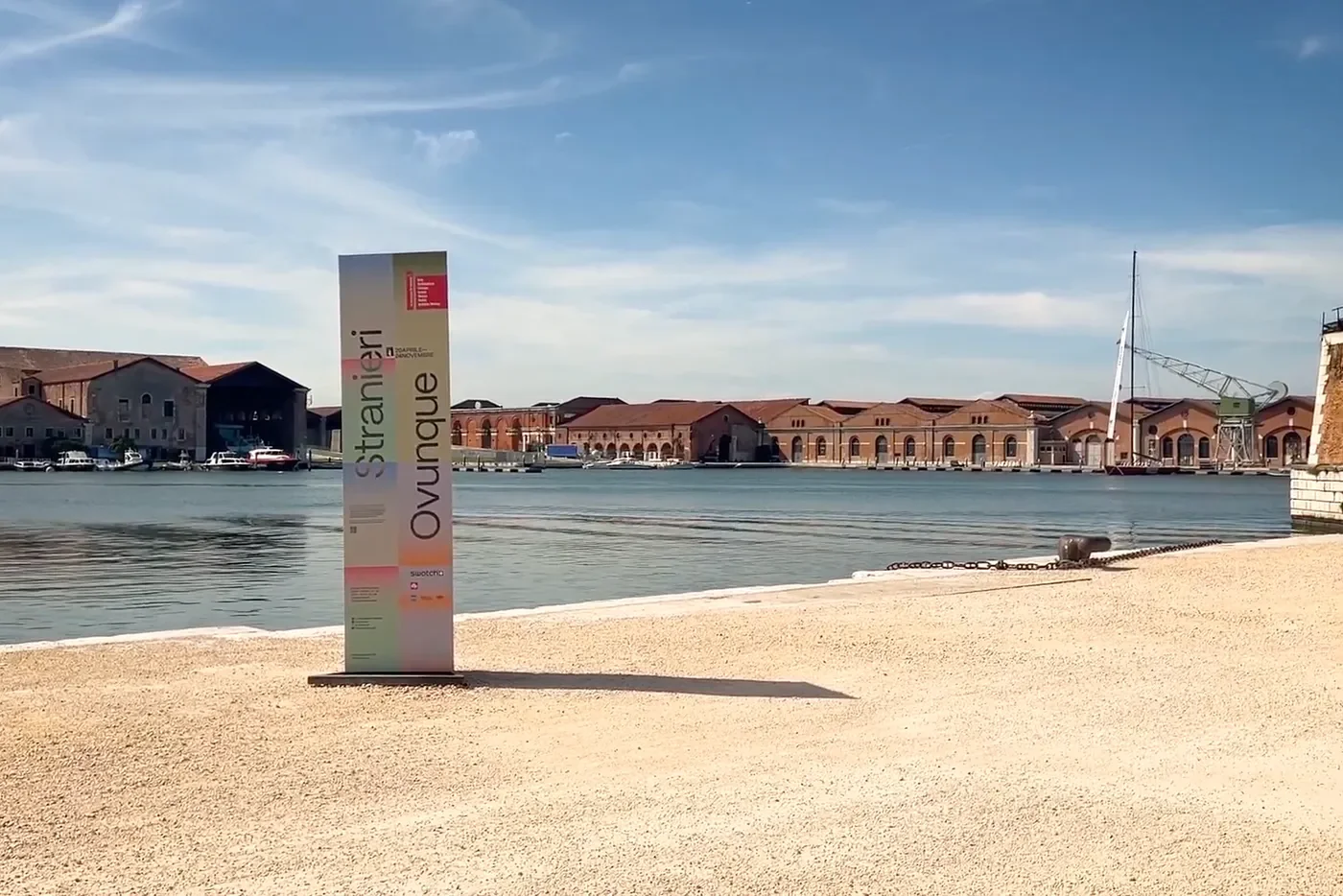
Views from the Venice Arsenale (Image Credit: Myself)
Informed by a world far from the utopian ideal of increasing universal connectedness, interdependence, and freedom. This state, in turn, highlights the difference and disparities conditioned by the arbitrary categories of race, gender, sexuality, nationality, and identity,⁴ which were all seemingly set in place and imposed by the ‘Global North’ to serve, reflect, and continually perpetuate an influence and hold upon their established systems of power. This condition is, rather unfortunately, strongly manifest in the arts and its discipline - on account of the subject’s reaffirming dependence and upholding of the Western canon and its Euroamerican nucleus. In his own words, Pedrosa’s curatorial intentions were, in some sense, to undermine and question the ‘traditional’ standard, and thereby, to a certain extent, in effect, ‘… a historical debt is paid to them’. As such, as a guiding principle, most of the 331 artists who were selected and featured have never participated in the International Exhibition, as well as, live in and between over 80 countries and nationalities. ‘For Venice, in fact, diversity has stood from the outset as a basic condition of normality,’ trumpets the President of La Biennale di Venezia, Pietrangelo Buttafuoco.⁵
‘south’ as a sense of identity_
Right upon approaching the Nucleo Contempraneo section, located in the Corderie of the Arsenale Venue, one is immediately greeted with a red neon sign installed atop the access granting entrance. Spelling out and distinctly introducing the title of the biennale, ‘Strangers Everywhere’, a signpost has been put down and a strong yet ambiguous impression has been made. Before venturing into the actual exhibition, one of Yinka Shinobare’s life-sized figure of an astronaut carrying a mesh sack, from his Refugee Astronaut series,* appears to be guiding the visitor towards the way in. Garbed in a spacesuit, adorned with the globally renowned artist’s signature “African” Dutch-wax fabric, the vibrant and eye-catching nomadic figure seems to symbolise a refugee who is about to embark on an expedition; perhaps drawing a parallel to the experience that is about to occur for an individual who is step foot into the Biennale Arte 2024. Promptly following this initial facile greeting, the expansive canopy installation that officially opens the main show and graces viewers in to the Arsenale venue is the (four-women) Mataaho Collective’s meticulously intricate and luminous, Takapau installation,* which poetically pays tribute to traditional māori weaving / textiles and its matrilineal wisdoms.
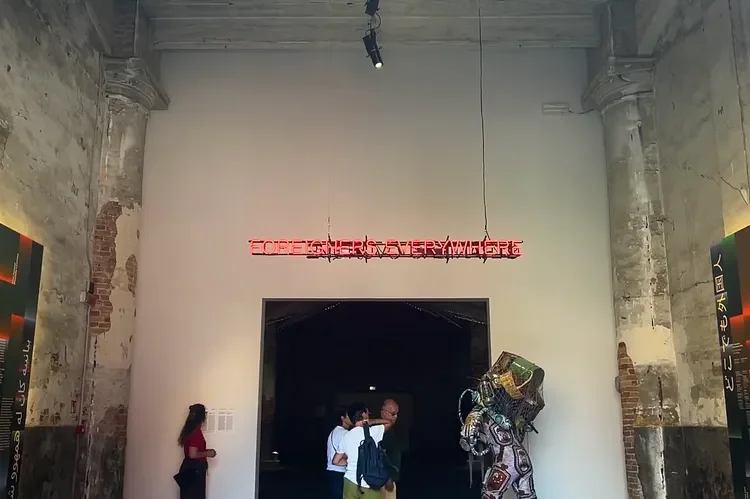
Entrance to the Corderie location (Image Credit: Myself)
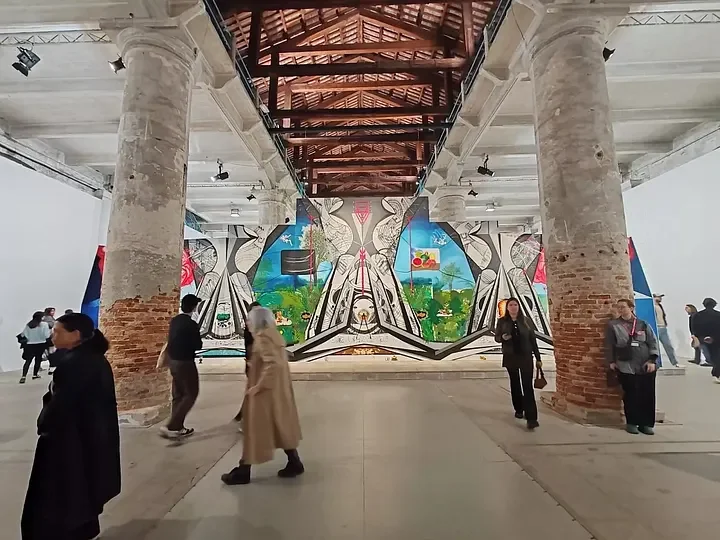
Inside the Arsenale exhibition site of the Venice Biennale 2024 (Credit: Rebecca Ann Hughes)
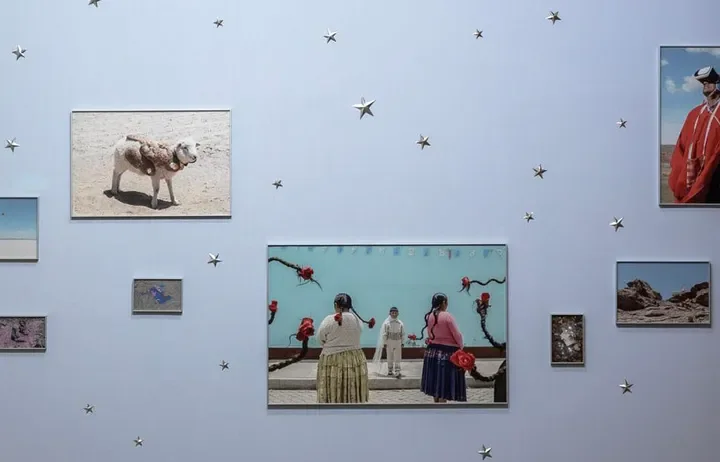
Installation views of River Claude’s Warawar Wawa (Credit: La Biennale di Venezia)
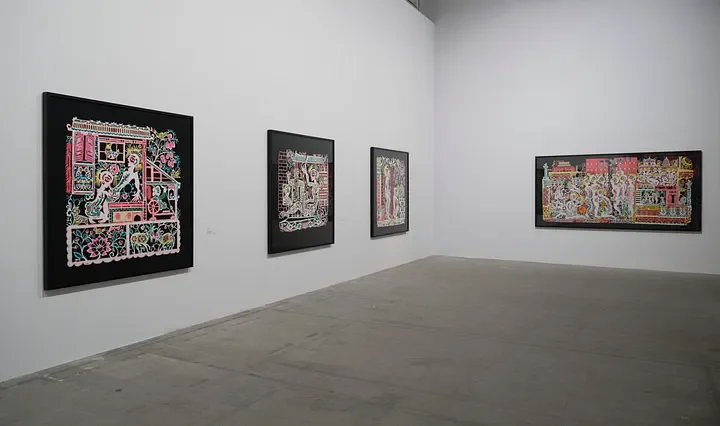
Installation views of Xiyadie’s paper-cut works (Credit: La Biennale di Venezia)
Moving through the subsequent rooms displaying the many contemporary artworks on show at the Corderie, an extensive amount of variety can be found in the different mediums, materials, techniques, ideas, histories, and subject matter. Some hits for me, personally, include the delightfully magical constructed photographic series of Warawar Wawa, 2019–2020, and Mita, 2020-present, by River Claude;* the intimately crafted paper-cuts that document the evolution of the artist’s queer life in China since the 1980s by Xiyadie;* the stylistic series of sixteen paintings, Full-Body Portraits, 2023–2024, depicting historical figures of African descent while evoking the gap as metaphor for uniting memories and histories by Dalton Paula;* the multiple artworks exploring the motif and structure of metal railings, which are a prevalent architectural feature in cities in the ‘Global South’, by Kiluanji Kia Henda;* the monumental commissioned multi-panel work loaded with sapphic fantasies, Rage is a machine in times of senselessness, 2024, by Frieda Toranzo Jaeger;* and the film, Pos’ se acabó este cantar, 2021, investigating the dominant narratives of masculinity found in enduring cultural tropes through the featuring of charros (Mexican cowboys), by Ana Segovia.*
The theme of celebrating the “foreigner” that defines this edition of the Venice Biennale can be well understood against the backdrop of a decentered art history. With a show of such scale, it is simply impossible to go through every work that was of note and memorable - however, the overall impression left from it was a subtle yet poignant one. In addition to those mentioned above, two other film works presented by female artists markedly stood out from the rest of my exhaustive list. Displayed and spread out across the specifically dedicated room, Bouchra Khalili’s The Mapping Journey Project, 2008–2011,* is an immersive installation made up of a constellation of individual videos projected onto large carefully hanging screens. Each installment presents one long static shot on a hand indelibly tracing a solid black line over a printed map as the account of the tortuous and perilous journey is being narrated by the singular participant who took it. All together, the project critically humanises the experience of migrants, and some refugees, and presents these undocumented peoples as active agents - it is definitely, in my humble opinion, a centerpiece in this exhibition.
Next, near the end of the Arsenale, I spotted a name that felt familiar - Charmaine Poh. Indeed, she is a multi-disciplinary Singaporean artist,* whose practice is focused on using experimental documentary film and photography to explore intersections of Asian femininity and queerness. On display at the 60th Venice Biennale are two of her works, Kin, 2021, and What’s softest in the world rushes in and runs over what’s hardest in the world,* 2024. Set in a local context, these films emphatically highlight and deal with the dissonance experienced by queer peoples in Singapore, whose desire to live and thrive is circumscribed by society’s idealisation of heterosexual nuclear families and the legislative entrenching of the definitions of marriage. In Kin, three queer youths contemplate on notions of home, care, and belonging, where public housing hinges on heteronormativity; while, on the other hand, What’s softest… offers a glimpse into queer parenthood, where such families lack legal legitimacy in the eyes of the state. Although these films shed a harsh light on the predicament of LGBTQIA+ people in Singapore, they also, simultaneously, present and envision queerhood as an open-ended field of possibility and as a site for alternate forms of community building.
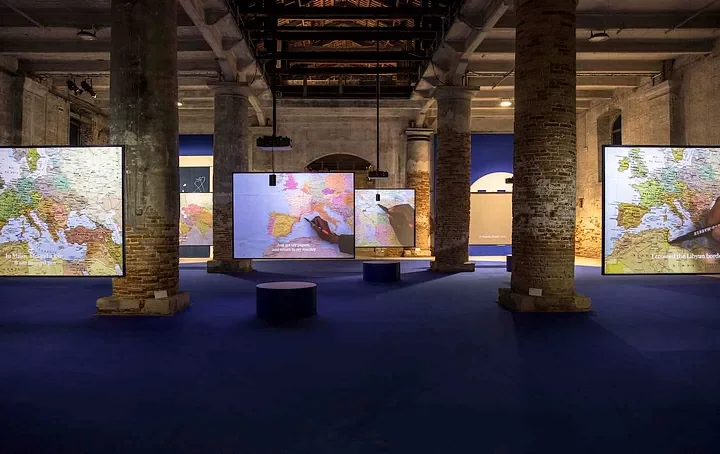
Installation view of Bouchra Khalili’s The Mapping Journey Project (Credit: La Biennale di Venezia)
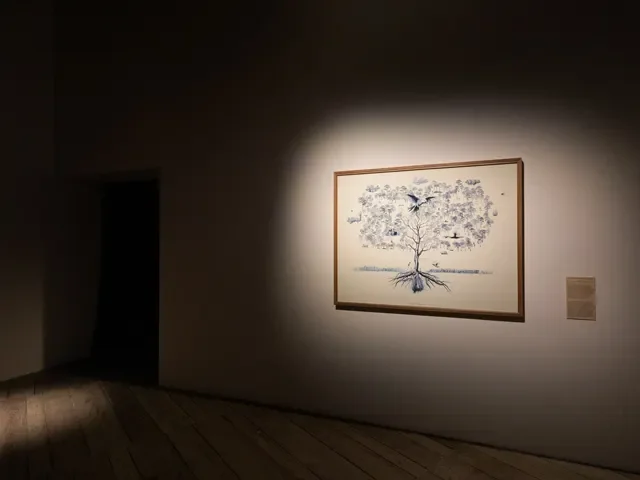
A Guide to a Secondary Forest of Singapore (Credit: Robert Zhao Renhui)
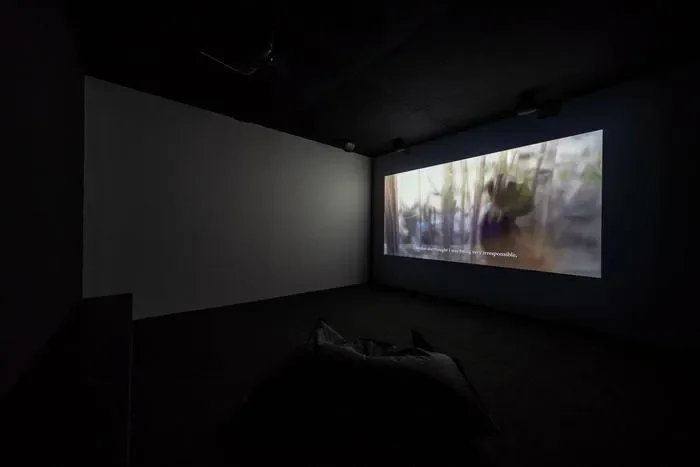
Installation view of Charmaine Poh’s What’s softest in the world rushes in and runs over what’s hardest in the world (Credit: La Biennale di Venezia)
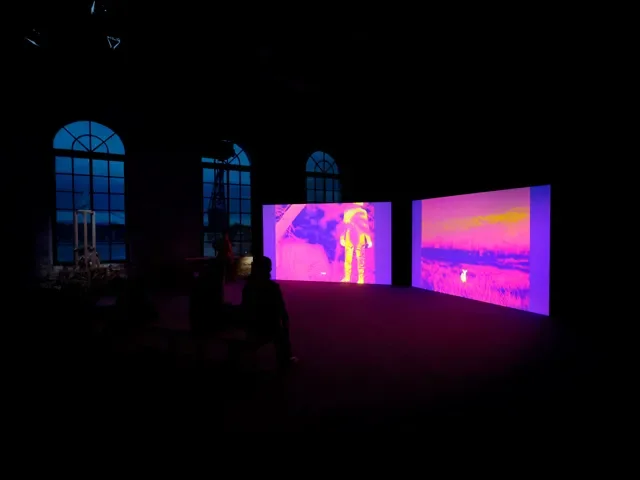
The Owl, The Travellers and The Cement Drain (Credit: Robert Zhao Renhui)
Singapore‘s national pavilion_
Organised and presented by the Singapore Art Museum, 2024 marks the 11th time Singapore is exhibiting at the national pavilions. Singapore has been participating at Biennale Arte since 2001,* and the many editions of the Singapore Pavilions have been consistently commissioned by the National Arts Council - it is no different for this year’s iteration. Located in a dedicated section on the second floor of the Sale d’Armi, a key site within the Arsenale which lies opposite the intersection between the long Corderie and Artiglierie buildings, is Seeing Forest by Robert Zhao, the artist, and Haeju Kim, the curator.* Before entering, visitors first encounter a framed digital printed map of an unnamed imaginary forest, A Guide to Secondary Forest of Singapore, presenting an overview of the artist’s exploration and accumulated observations of Singapore’s ‘secondary forests’.* These are the forests that have regrown over land previously disturbed or deforested due to human intervention and development - these forested zones, now a quotidian part of the Singaporean landscape, crucially serve as a threshold between the old-growth, or primary forest, and the urban environments, and thus, contain some potential of a multifaceted existence, both in the imagination and in reality.
Through an assemblage of video and sculptural installations, three other works are centrally on show in Seeing Forest, 2024.* A layered filmic essay, The Owl, The Travellers and The Cement Drain, presented in a two-channel format, hypnotically showcases the contrast and interaction between the natural and man-made elements; constructed out of found objects, the structure of Trash Stratum resembles a crumbling cabinet, which recalls and challenges the concept of a cabinet of curiosities, along with its colonial associations; and, last but not least, Buffy, a digital print of the Buffy fish owl, a bird native to Southeast Asia, with its back turnt to the viewer, evoking some sense of unsatisfactory concealment and discovery. The presentation, in effect, encapsulates Singapore’s histories of settlement, colonisation, and migration, and meditatively considers the complex yet mutual entanglement of human and non-human co-existence. Complementing the theme of the Biennale, Seeing Forest explores and reveals the often missed moments of understated dependence between human society and nature - and offers a tribute to the transitional forests found along the margins of urban life in Singapore. It asks the question of -who is the ‘foreigner’ here?
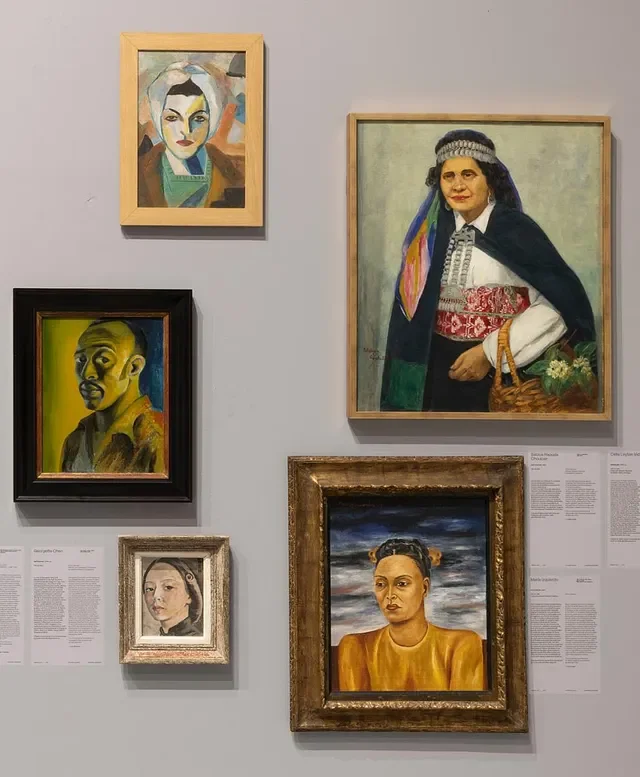
Exhibition View of Artworks on display at the Venice Biennale (Credit: National Gallery Singapore)
Singapore in the ‘Global South’
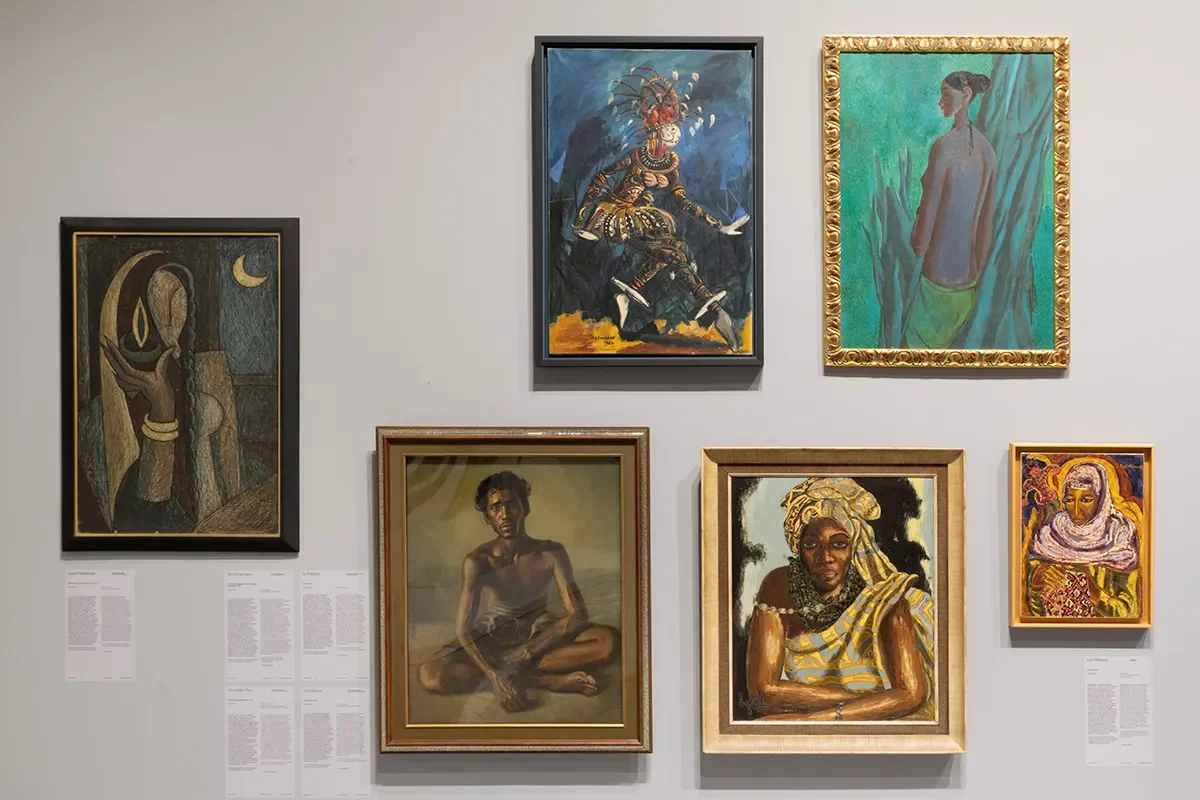
On top of that, this year notably also initiates the National Gallery Singapore’s first-ever invitation to take part in the Main Exhibition of the International Art Exhibition — La Biennale di Venezia. The roster of selected artworks, comprising of self-portraits and representations of the figurative, such as the working class and indigenous peoples, are featured in the Nucleo Storico section, under the ‘Ritratti/Portraits’,* at the Central Pavilion of the Giardini venue. This portion of ‘Foreigners Everywhere’ seeks to expand the history of modernism in art history beyond Europe and North America by gathering works from the ‘Global South’, including artists whose trajectories took them across borders and contexts over the course of the 20th century. All over Latin America, Africa, the Middle East, and Asia, many artists were either in touch with or at least acutely aware of European modernism through their exposures and opportunities to travels, studies, local exhibitions, or publications - yet they did not wholly emulate or imitate ‘the West’ in their artistic practice, instead these boundaries-pushing artists brought in their own particularly personal and powerful reflections and contributions to their works.
To illuminate the necessary and significant essence of diversity in the eight paintings picked, as they bear the weight of being exemplary of the region, the National Gallery appeared rather intentional and deliberate in their shortlisting process. This is affirmed by simply surveying the register, which will reveal the variety of nations presented, consisting of Vietnam, Indonesia, Malaysia, and, of course, Singapore, and demonstrate the different manifest dynamics. For instance, Lê Phổ is an artist who has migrated and settled in a colonial metropolitan centre yet chose to convey a restrained, harmonious, and more traditional image in his work Jeune fille en blanc (Young Girl in White), 1931; while Hendra Gunawan and Affandi are amongst the most prolific and renowned painters, as both of them had considerable success and were celebrated as representatives of Indonesia. Furthermore, three out of the eight were crucially female whose practices and biographies suggest the critical gains that can be made when efforts are made to recover them for wider recognition. They were Singapore’s very own Georgette Chen; Emiria Sunassa from Indonesia, and the Malaysian-born Singaporean Lai Fong Moi.
With more than 8,000 artworks in its collection, the National Gallery Singapore holds one of the world’s preeminent collections of art from Southeast Asia * - and as such, the submission of a small fraction of the institution’s holdings to the Venice Biennale signals a momentous occasion for the dissemination of the region’s artistic ventures onto an international stage and presents a varied alternative to the dominant narratives constructed and projected by the West. The chosen group of eight works, accordingly, reflects this topos and, together, represents the diverse and multitudinous backgrounds and perspectives flourishing within Southeast Asia. Displayed alongside other representations of subjecthood from the ‘Global South’, in a dense salon-style hang,⁶ a mode of presentation harking back to the traditional mode of exhibition from 17th century France, all on a white wall, which is reminiscent of the ‘white cube’, an act of reversal is occurring. In place of the expected display of Western artworks and artists, are pieces from other largely overlooked cultures and geographies. Through this insistence, the issue of the Eurocentric art historical “canon” is brought to the fore and reconsidered.
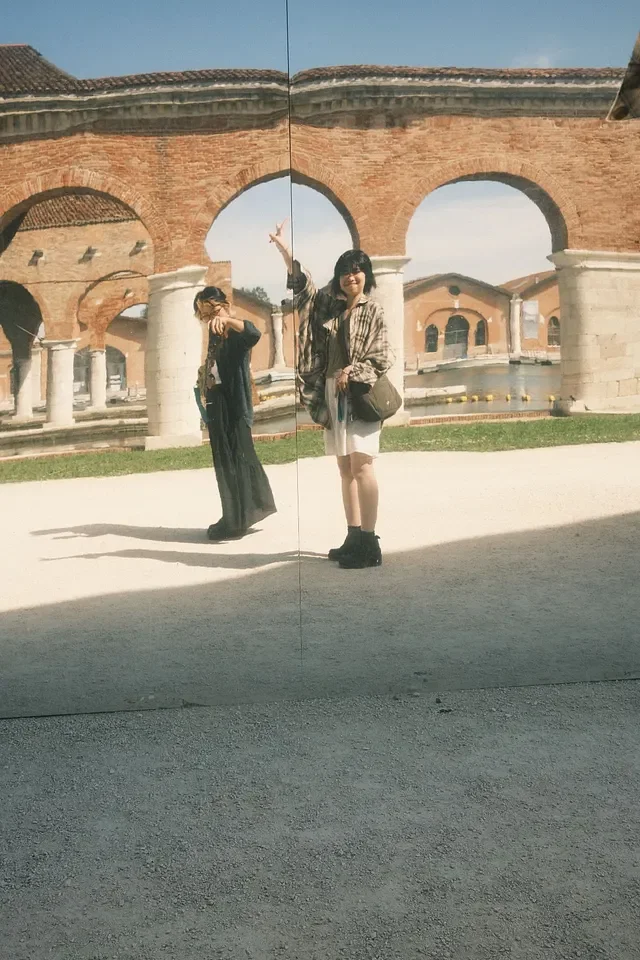
me and my friend at the Venice Biennale, 18.06.24
final thoughts_
All in all, the Venice Art Biennale is a lot to digest and biennales, in the art context, are complex entities. I will always remember Adriano Pedrosa’s “Foreigners Everywhere — Stranieri Ovunque” well fondly, as the circumstances that surrounded my personal experience of the entire event will always hold dear and sentimental value. It is always beneficial to be mindful of the manner in which cultural institutions and art exhibitions operate in order to critically approach and appreciate the artistic narrative(s) produced and on display. The ‘Global South’ as a metaphor for what and who is furthest from power or pushed to the periphery is undeniably the central focus of Pedrosa’s curatorial aim and to offer the dismissed, neglected, and denied such an acclaimed international platform is indeed a commendable effort. Nevertheless, with any inclusion, there will always be exclusions and absences - and objectively, with any big spectacle of an art show, of such immense scale, there will always be unintentional conflations, murky gestures, and questionable oversights that will only reveal themselves in hindsight. The difficult and politically laden task of progressing the discourse in global contemporary art requires quite the balancing act and as if it were in a bid to generally please and not rock the boat, the voice of this event, ultimately, to me, seemed a tad timid and placid in its address.
¹BIENNALE ARTE 2024, Online Brochure : “FOREIGNERS EVERYWHERE” — Adriano Pedrosa
²further reading — Jonathan Keates, La Serenissima: The Story of Venice, (Bloomsbury Publishing, 2022)
³Hugo Pratt, Sirat Al-Bunduqiyyah, ‘Fable of Venice’, (L’Europeo, 1977)
⁴further reading — Edward W. Said, Orientalism, (Penguin Classics, 2003)
⁵BIENNALE ARTE 2024, Online Brochure : “BIENNALE ARTE 2024” — Pietrangelo Buttafuoco
⁶Alexandra Morrison, A Little History of the Salon Hang, MOMA — Magazine, (Aug 9, 2024), https://www.moma.org/magazine/articles/1106